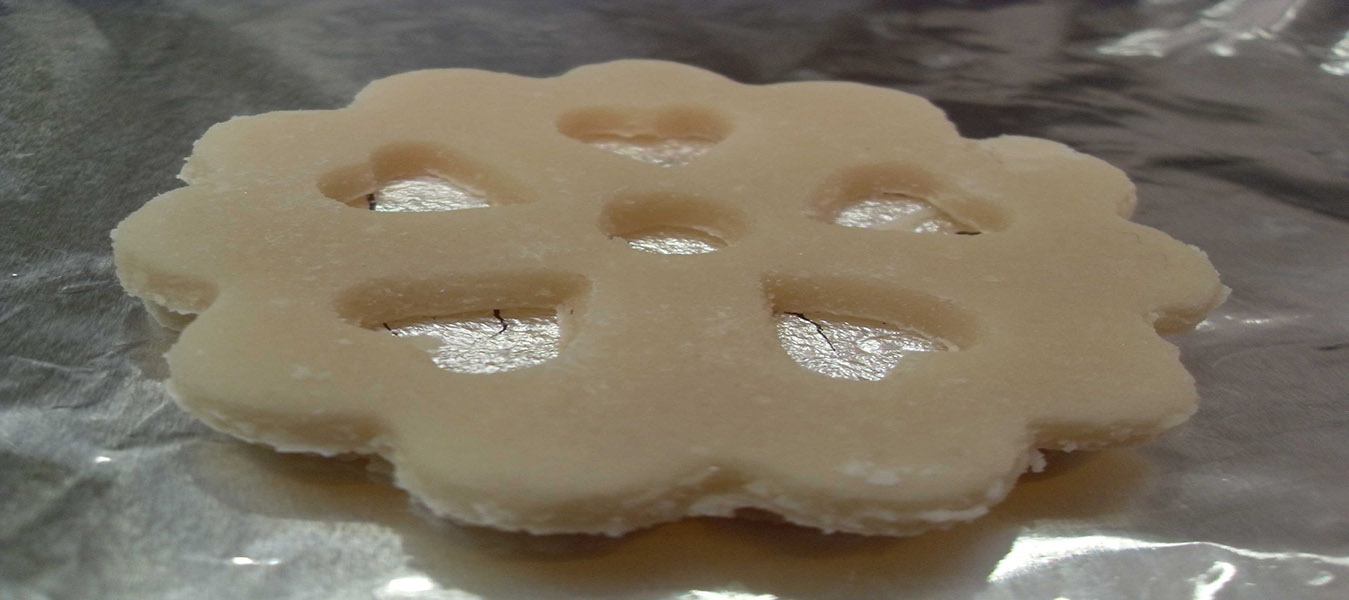
Almonds, sugar and patience
Everything is done by hand — the peeling, the kneading, the rolling, the pressing of each piece through moulds and stamps that have been used for generations — and a batch takes hours from soaked almond to finished tray. That is why we make every order fresh after it is received.


Almonds, sugar and rose water
There is nothing hidden in Badam ki Jali. The original recipe was milk, egg white, ground almonds, sugar and rose water — mixed, kneaded well, cut into lattice shapes and baked in a pan on hot coals. That baking gave the skin a hardness that made the sweet very delicate (khasta), breaking at the slightest impact. No ghee or oil. It is, in essence, an almond marzipan that happens to be baked; what makes it Nawaiti is not what goes in but how it is handled — and the stamps and moulds it is pressed with.
The jali — the net or lattice that gives the sweet its name — is not an icing or a decoration added on top. It is the perforated pattern the mould leaves in the almond dough itself, which is why the moulds matter as much as the recipe. We make ours from the family’s original recipe, with organic, eggless and gluten-free options on request.
Almonds
The nuts are soaked, then peeled one by one by hand — never left with a scrap of skin — dried, and ground to a fine flour. Almond is the whole body of the sweet: there is no flour, no khoya, no cashew in the family recipe.
Egg white & milk — or not
In the original recipe egg white and a little milk bind the almond flour and sugar into a dough that bakes crisp. We also make an eggless version, and gluten-free and organic options — tell us when you order. The egg peosi, as its name says, is made with eggs by design.
Sugar, rose water, saffron
Sugar kneaded with the almond flour is what sets the dough; rose water scents it. Saffron colours the Ashrafi and the peosi. A leaf of edible silver varq goes between the two layers of a warqi jali. No fat touches the jali — “do not grease your hands with oil or ghee”, runs one old instruction.
From soaked almond to finished tray
Six stages, most of them manual. Making this dessert is quite labour-intensive — which is why every order is made fresh after it is received — but the end result is a creation that looks as good by itself as it does arranged in a tray with Ashrafi and the other shapes.

Soak & peel
Almonds are soaked — or briefly boiled — until the skins slip, then peeled by hand, one at a time, and dried. Nobody skips it: any fleck of peel left behind shows in the finished piece.


Grind to a fine flour
The peeled almonds are ground to a fine flour and then worked to a paste smooth enough to be called silken. In the old kitchens grinding was done by hand on stone; a mixer takes the heaviest of it now, but the last of the work is still by hand.


Mix with sugar & knead
Almond flour, sugar and rose water — with egg white and milk in the original recipe — are mixed and kneaded well into a soft, white-to-off-white dough much like marzipan, then rested until it is smooth and pliable enough to roll.
.jpg)
Roll & press through the moulds
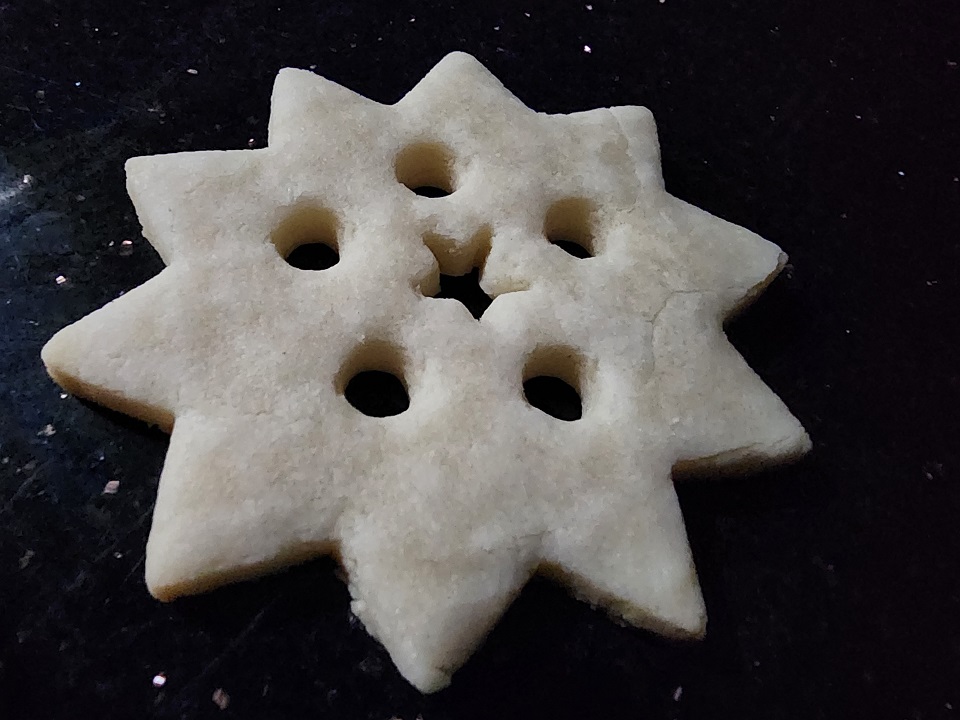
The dough is rolled out into a large, roti-like sheet. Then come the moulds and stamps — metal today, wooden in the old days; in Hyderabad the small steel cutter called the chapa — which press rounds, stars, betel leaves and flowers out of the sheet, leaving the perforated jali in the dough itself. Names and lettering are cut by hand for special orders.
Bake lightly
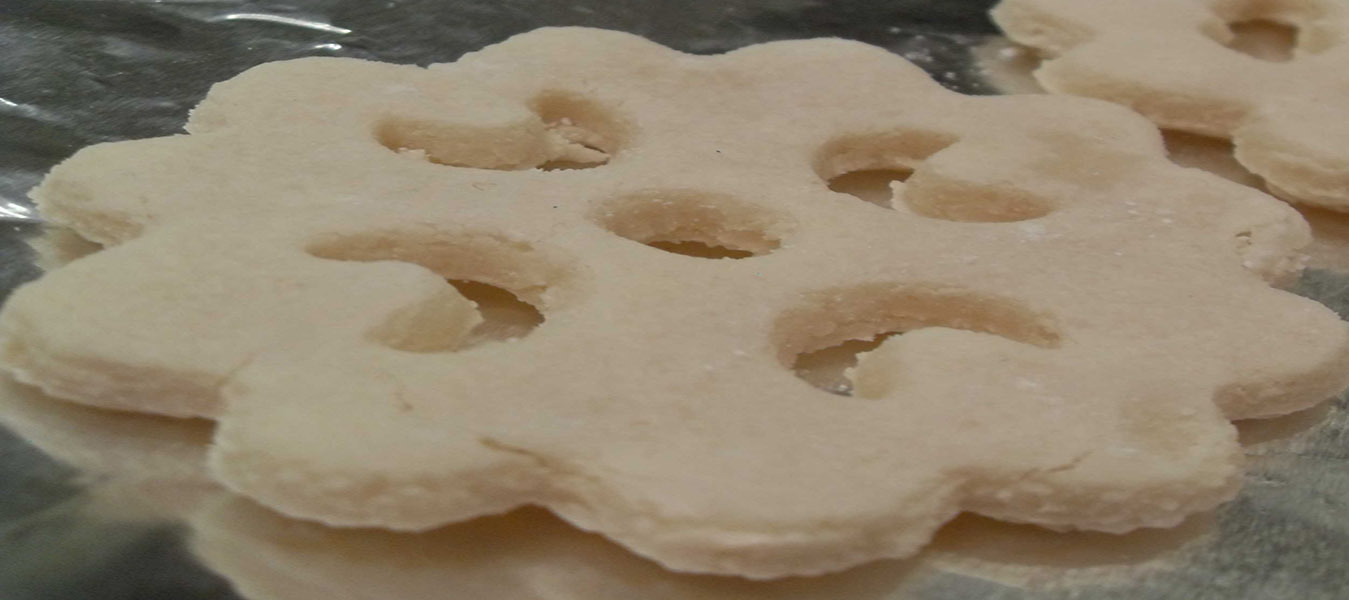
The shaped pieces are baked — on hot coals in the original recipe, in ovens today — for a quarter of an hour or so: a light bake, for colour and that delicate khasta crispness, not a hard one. Ashrafi is the exception: the almond coins are never baked.
Finish: silver, wrapping, trays
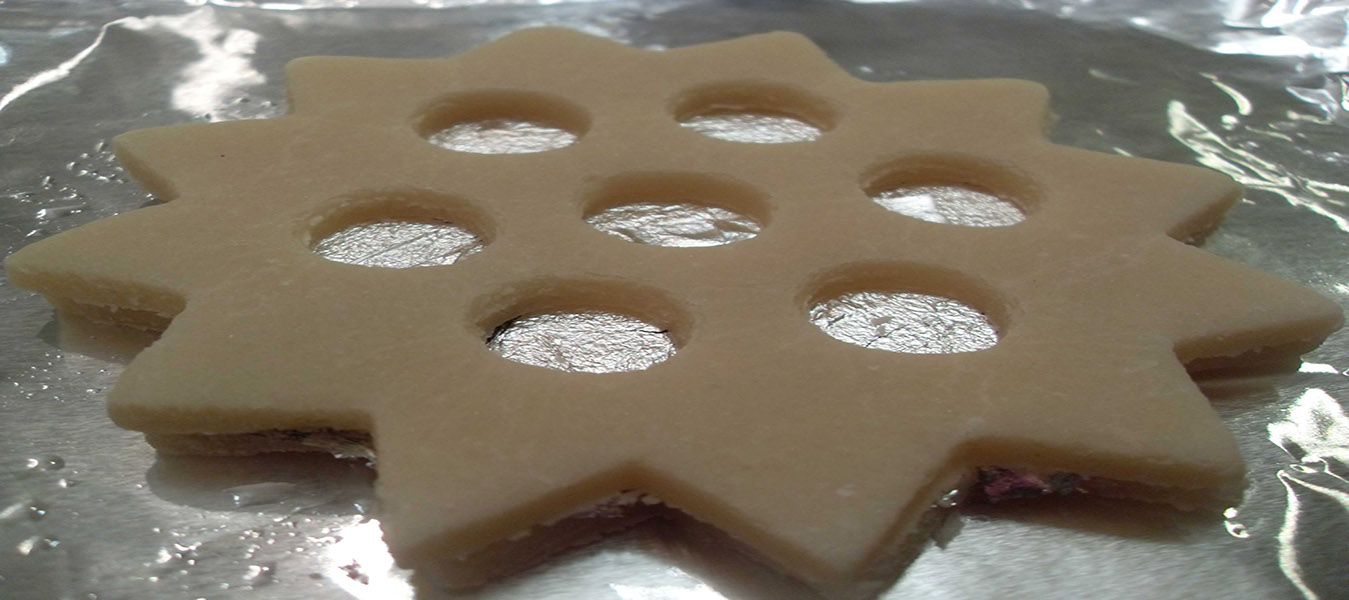
For a warqi jali, two thin layers are joined with a leaf of edible silver varq between them, so the silver shows through every hole. Each piece is then individually wrapped and packed in layers to ship — or arranged, with Ashrafi, paan and decorations, into the trays that go out for the pre-wedding Sanchak ceremony, the wedding feast or Eid.
For a sense of the labour: makers in Hyderabad describe about an hour to cook a batch of dough and fifteen to twenty minutes in the oven (Wow Hyderabad, 2023), four to five hours for the whole process (The Better India, 2022), and a week for a single 1,000 kg festive order (The News Minute, 2019).
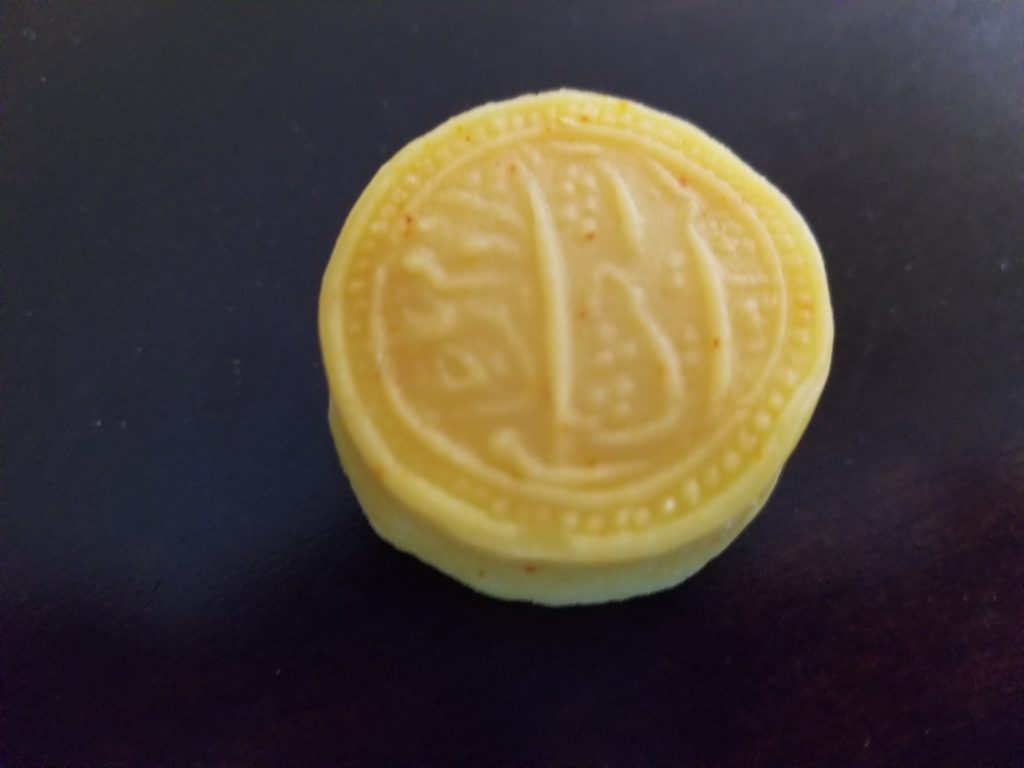
Ashrafi is different
Ashrafi — the almond coin — comes out of the same kitchens and the same dough, but breaks almost every rule above. It is not baked. It is made in yellow, the colour of the gold ashrafi coins used as currency in the independent State of Hyderabad before its merger with India — the word is a translation of that coin. And instead of being cut, it is pressed between two dies, so that both faces carry engravings that describe the contents of the dessert. The edges are then trimmed and smoothed by hand.
The family telling is that the inventor of this dessert, and the poet who wrote the lines on both sides, was Nawab Mohammed Ghouse Khan Bahadur, ruler of the State of Madras in the 1800s. The Persian couplet names rose, musk, almond and sugar-candy — “Gulab wa mishk wa badam wa nabat ast / Ghalat kardam, tamam aab-e-hayat ast” — roughly: rose and musk and almond and sugar-candy it is; no, I was wrong, it is the water of life itself. As the recipe evolved, today’s coin no longer contains the rose water or the musk. If you do not see the engravings with the ingredients on it, it is not the original design.
The result is soft where the jali is crisp, and it carries a meaning of its own: named after the Deccan’s royal coins, it symbolises prosperity and is handed out as a favour at weddings.
Hardly three or four shops
“There is no secret but it’s the love… that makes it almost impossible for the others to make a replica.”— a maker of the Aziz Bagh colony, The News Minute, 2019
In 2019 The News Minute could count “hardly 3-4 shops in the city” selling Badam ki Jali. By 2026 a Hyderabad baker was telling Deccan Chronicle that such “royal desserts” were preferred by only around 10 per cent of customers, and INTACH Hyderabad observed that the expertise required to make them has declined.
The reasons are all in the process above. Almost every stage is manual — the soaking and hand-peeling, the rolling of the sheet, the pressing of each piece through moulds and stamps that are passed down within a family and, in the case of the coin dies, kept exclusive to it. Getting the cookies right is difficult precisely because most of the work is done by hand; not all jalis are Nawait, and a copy without the family’s stamps is easy to tell.
It has also, for the most part, been women’s work, and it is the women of the family who have carried the recipe from generation to generation. Mixers and ovens have modernised the heaviest of the labour, but each piece is still shaped by hand — which is why we make every order fresh after it comes in.
Shelf life, storage and travel
- Shelf life
- Jali and Ashrafi are best eaten within about a week of arriving; peosi and lauz sooner. Everything is made fresh after your order is received.
- Storage
- Cool and dry, in their wrapping, in an airtight box. Not the refrigerator.
- Travel
- A dry, oil-free sweet that travels well: each piece is individually wrapped and packed in layers, and store packs ship free anywhere in the USA by UPS Ground.
- Serving
- Traditionally a dessert, served after the meal at weddings and festivals — and with tea at any hour.
- Portion
- Store packs of 15, 20 or 40 pieces; single pieces on the products and prices pages; trays made to order.
- Ordering
- Small batches, made to order, so allow time — the store or contact us.
The makers on the making
Moulds of different shapes- roses, betel leaves, stars, and diamonds- are filled with dough and baked in huge ovens.
— The News Minute, 2019
These recipes were whispered down through generations. We are just making sure they are not forgotten.
— Naina Roshan Khundmeri, Deccan Chronicle, 2025
It’s a little difficult to get the cookies right as most of the work is done manually.
— Ali Hussain, The News Minute, 2019
Now see what the moulds make
Warqi and non-warqi jali, stars, Ashrafi coins, paan, almond strawberries, peosi and lauz — the varieties, and how to order them.